Thursday, April 22, 2010

Battle of Midway, Robert Benney

During World War II more than 100 U.S. servicemen and civilians served as "combat artists", recording what they experienced in ink and paint. I think it is really cool that they did this! I can't imagine being able to, I guess, be focused enough to do this, but art must truly be their outlet. The Battle of Midway was a decisive American victory and turning point in the war in the Pacific--and here we have someone's impression of what it looked like.
I can see a person and part of a Japanese plane, or at least flag in the water. The sharp contrast and the rough strokes really give me a feeling of panic and fear, like this is war.

Monday, April 19, 2010

Connection Across Time: "Made in Japan"

Surprised as I was about the Japanese impression of Americans as being materialistic, I recalled reading an article in Time (a while ago) about Japan's new consumer culture.
http://www.time.com/time/magazine/article/0,9171,1832712-1,00.html

Basically, after the defeat in the war, nationalism was associated with suffering. In Japan, it became cool to be westernized, to eat European food and drive European cars, have European (or American) tech-gadgets---the article cites Bang&Olufsen phones and iPods. Now, however there is the desire to promote Japanese culture at home, and it follows, throughout the rest of the world.
The whole thing strikes me as ironic: in Japan and other countries in the East, they idolize Western culture, but we too are fascinated by Eastern culture. Americans feel so "cool" when they drink "chai", tofu appeals to our health-food fad, and sushi-bars are glamorous. I see wallpaper, furniture, dishes, clothing full of eastern influence. For me, cherry blossoms--> Japanese art!

WWII, Part I: What I Learned about Japan and the Holocaust

I'm glad to learn a little about Japan and China during this unit--this being a European History course, sometimes I feel like I'm missing out on World History. Although I suppose it's all a bit intertwined.
The Japanese mindset on the eve of WWII is quite fascinating and a little appalling. First of all, I thought it was sad that they sent their sons at a young age for military training. I know this has been a common occurrence all over the world and throughout history, but I still think it is wrong. You can't just have everyone be in the army--you need scientists, doctors, lawyers, writers, teachers, etc. They viewed Americans as decadent, lazy, materialistic and egocentric, yet they clearly had issues of their own. America, egocentric? The Japanese had their own extreme superiority complex that compelled them to massacre 300,000 Chinese in the Rape of Nanking! I find it puzzling that they believed themselves to be a superior race, or superior among the Asian races. I heard that some people in class were offended by the comment that the Chinese and the Japanese were the same race. Please allow me to vent here: Stating that they are the SAME RACE does NO DISRESPECT. The Chinese and the Japanese are two DIFFERENT NATIONALITIES, and they have DIFFERENT LANGUAGES AND CULTURAL CUSTOMS. However they are considered to be the same race. NATIONALITY, CULTURE, AND RACE ARE SEPARATE. So chill out.

I have studied the Holocaust in some way, shape, or form every year since fifth grade, and even then, that was not the first time I heard about it. What I heard for the first time today, was the story about Pius XI, or "Hitler's Pope". It is an interesting story because it was new, and it seems to be kind of complicated. I mean, I wouldn't blame someone for being afraid (of Hitler) but I also believe, that with power comes responsibility (yes, I got that from Spiderman). I understand the desire to maintain diplomacy, but I think that he should have protested the evacuation of the Jews in Rome; I believe he could have made a difference, and it never hurts to try. The video certainly did not make me want to believe this Pope as innocent, when it said that all he did was beg the Axis not to bomb Rome. Since I wasn't in his position, I hate to judge. Unfortunately, the evidence doesn't look very good.

I can't help but find it offensive when Holocaust-denial is associated with Islam. I am Muslim, and I ASSURE you, this is not a Muslim belief. Every religious group has been persecuted at some time or another, so how could one not feel sympathetic? If someone denies the Holocaust, they have a personal...problem. SHAME ON ANYONE WHO DENIES THE HOLOCAUST OR ANY SIMILAR ATROCITY IN THE NAME OF RELIGION. Also, I think some people need to be reminded that Mahmoud Ahmedinejad (a "Holocaust-denier") is NOT a representative of Islam, he is merely the President of Iran.

Tuesday, April 13, 2010

Connection Across Time: the Large Hadron Collider

Discoveries in physics in the early 20th century regarding the structure of the atoms led to big questions, especially about the nature of these subatomic particles. It was during this era that Albert Einstein derived his formula relating mass and energy: E=mc^2. Although we now know much more about protons, electrons and neutrons, there are still other questions to be answered. For example, what is the nature of particles smaller than electrons? Einstein's formula also led to the development of the Big Bang theory for the creation of the universe. CERN's Large Hadron Collider in Geneva is one example of how scientific questions of the Age of Anxiety continue to influence today's research. In simple terms, the LHC accelerates two protons at extremely high velocities into each other to see what happens when they collide--to examine how the particles break up and also to recreate the conditions of the Big Bang and observe how the universe was created. There is also talk of building a particle accelerator in the tunnel of the Circle Line in the London Underground!
http://www.independent.co.uk/news/science/hadron-collider-ii-planned-for-circle-line-1932744.html

Monday, April 12, 2010

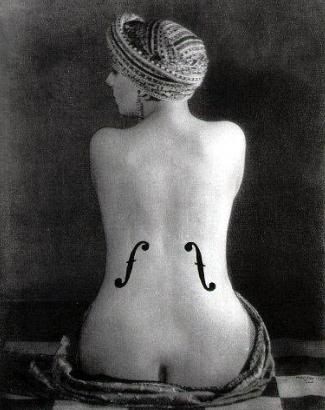
"Le Violon d'Ingres" , Man Ray (1924)

This is a photograph, and the f-holes are painted on the woman's back. Man Ray was a Philadelphia born photographer, but was closely associated with European artists. He brought dadaism to New York. This piece is an example of a photo montage--it combines two media. One of the reasons it first caught my eye, and one of the reasons I think it is so beautiful is that it is so clean and simple. It is art that provokes thought without overwhelming the brain with loud colors and shapes. Her smooth white back, with a gentle curving silhouette, is the focus. It is remarkable how much it is shaped like a violin. The way she has turned her neck and is staring towards the left is very graceful. I feel very at peace looking at this picture. I think this painting means that music is inside a person, and that person lets it out. I've heard it said that the violin is the closest sound to the human voice; sometimes I've felt that I am literally singing on my violin. Perhaps there is music in not only this woman's voice, but in the way she breathes. Perhaps the way she walks is like a dance. Perhaps there is even a kind of music in her love or her actions. I know Dadaism is about breaking the rules, but when I look at this picture I don't think about rules being broken--I think about truth or simply human nature being revealed.

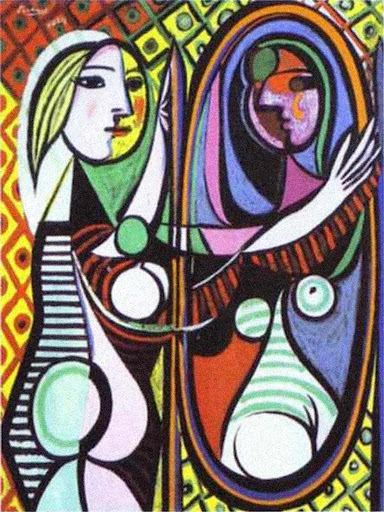
Girl Before A Mirror, Pablo Picasso

I must confess that I am not really a Picasso fan. I respect his artwork but I do not find it attractive. However, I don't mind this painting. It displays Picasso's characteristic geometric shapes, and bright, contrasting colors, yet the face of the figure is not too distorted. For this reason, I felt like I could relate to the painting. I look in the mirror everyday, we all do. The image in her mirror is not a reflection--the colors are different. They are darker. Or perhaps, the purple in her face represents something "richer", more colorful than white. Looking in the mirror can be like this--sometimes we see someone staring back at us that we don't want to be. Sometimes a glimpse in the mirror gives us confidence, we see the "color", the brilliance in ourselves that no one else sees. Perhaps she is reflecting about aging and mortality, on beauty that fades. I think it is possible that she is pregnant because of the shape of her stomach. Perhaps she is thinking about life and death, what it means to bring a child into the world, or her transition from innocence to womanhood. Notice that she is reaching out to the mirror, to her reflection--is she longing for the past or eager for the future?
According to the MoMA's website this is a portrait of Picasso's young mistress Marie-Thérèse Walter, one of his favorite subjects in the early 1930s.

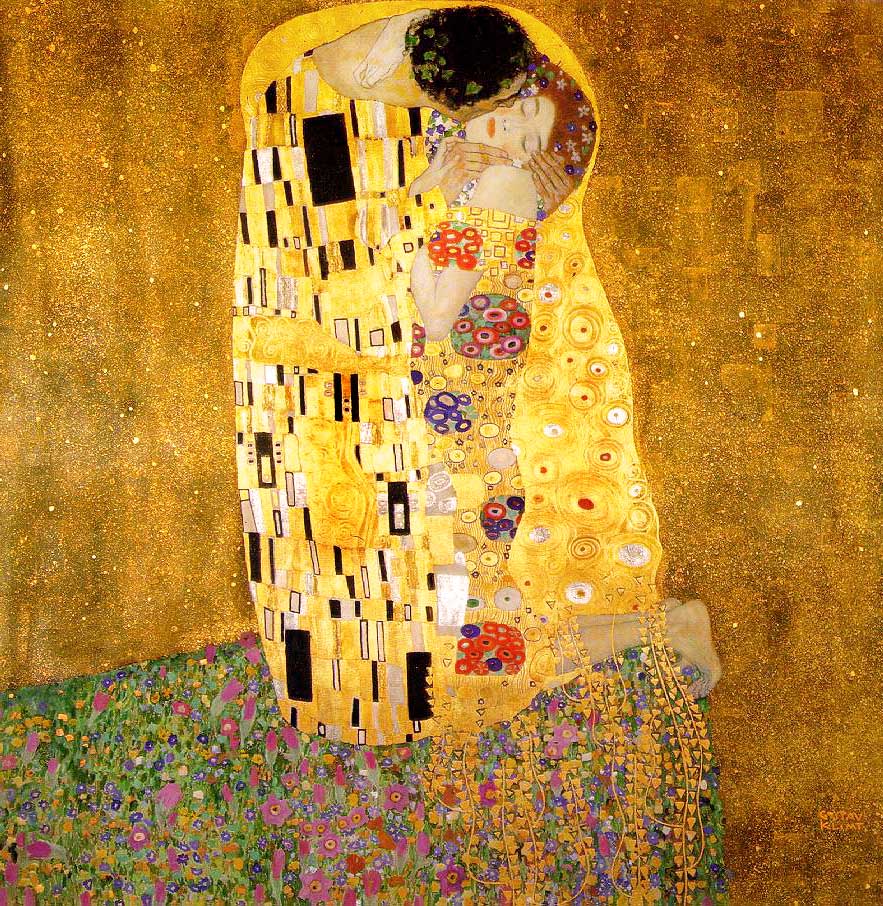
The Kiss, Gustav Klimt

Gustav Klimt is perhaps Austria's most famous modern artist. He lived mostly before WWI and the Age of Anxiety, but I believe his paintings, and the Secessionist movement, are important in the developments of European art that we studied in class. In fact, like Picasso and Dada, Klimt employs geometric shapes to depict all but the faces, hands, and feet of the two figures. The flowery field at the bottom is two-dimensional, which is another characteristic of modern art. Not only does Klimt use bright colors, he uses gold. Actually, gold leaf is used on their clothing and the background!
This is one of my favorite paintings. Klimt is known for his eroticism, but I do not choose to interpret it as an erotic painting. It is sweet, serene, and tender--just look at her face. For some reason, the bottom green part, perhaps the striking contrast of the purple flowers with the green and gold, always catches my eye. I had the pleasure and opportunity of seeing this painting in person this summer when I was in Vienna. It is at the Belvedere, an old summer palace of Prince Eugene, an Austrian army officer, which now houses modern art. This is one of the most famous paintings in Austria--this and Klimt's portrait of Adele Bloch-bauer. The image is plastered over every imaginable tourist souvenir--mugs, calendars, ties, even teddy-bears.